
Rethink Everything You Know About Networking: 5 Surprising Strategies for Real Connections
Rethink professional networking with 5 proven strategies to build authentic relationships, ask better questions, master follow-ups, and grow your career without feeling fake.
CAREER DEVELOPMENT
E. O. FRANCIS
2/2/20267 min read
Introduction: Why Networking Feels So Awkward (And How to Fix It)
For many professionals, the very idea of networking is uncomfortable. It can make people feel "phony-even dirty," like they are being exploitative or inauthentic. If you've ever felt this way, you're not alone. But the problem isn't the act of professional networking itself; it's the outdated, transactional approach that focuses on what you can get rather than what you can give or learn. This perspective turns a powerful career tool into a dreaded chore. By making a few key mindset shifts, you can transform networking from an obligation into a genuine and highly effective career-building activity.
This article will walk you through five surprising strategies that reframe the entire process, helping you build a powerful network of authentic relationships, not just a list of contacts. We will explore how to:
1. Shift your mindset from taking to learning.
2. Replace your elevator pitch with a compelling career story.
3. Ask questions that create immediate rapport.
4. Master the art of strategic follow-up.
5. Leverage an introvert’s natural strengths for deeper connections.
1. It’s Not About You, It’s About Your Mindset
The primary reason networking feels inauthentic is a "transactional" mindset focused on personal gain. When your goal is simply to extract value from others, the interaction naturally feels forced and self-serving. The first and most critical strategy is to reframe the purpose of networking away from yourself and toward a more meaningful, relational goal.
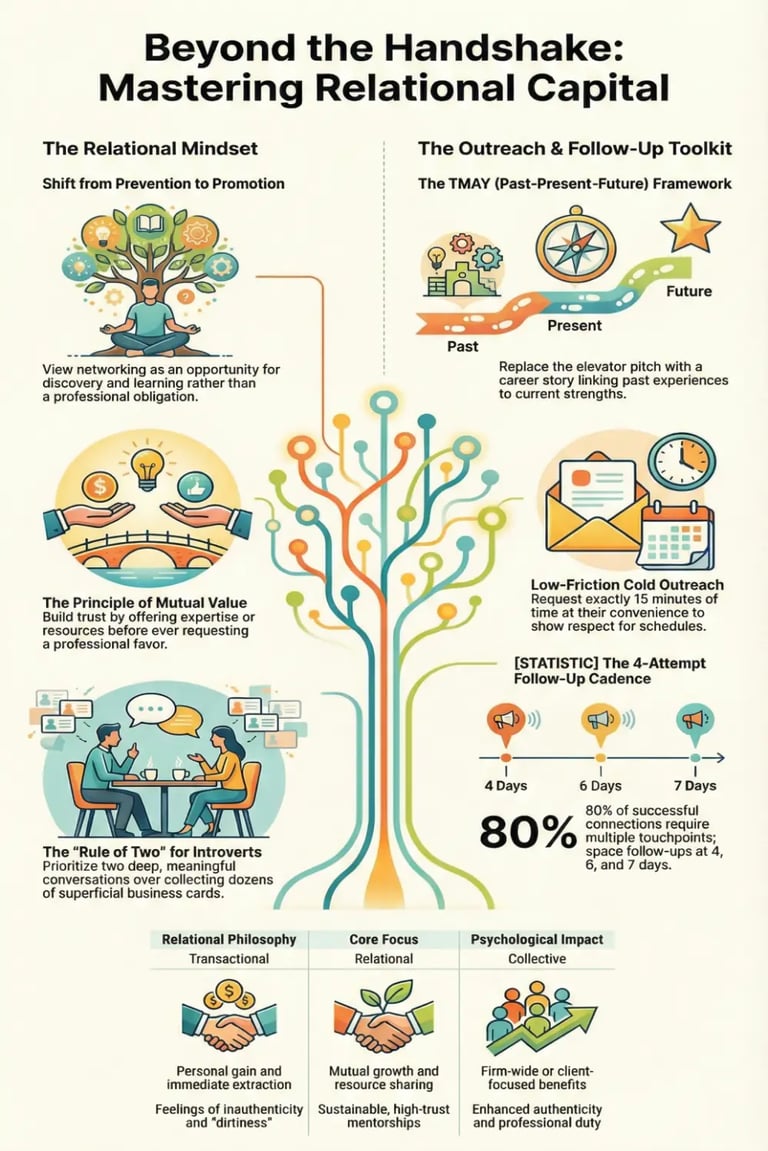
• Focus on Learning: Adopt what psychologists call a "promotion mindset," where you view networking as an opportunity for discovery and learning, not an obligation you must endure. Instead of seeing an event as a chore, approach it with curiosity and an open mind about the interesting ideas, experiences, and people you might encounter. This simple mental shift can make the entire activity feel exciting, worthwhile, and far more authentic.
• Find a Higher Purpose: Another powerful technique is to frame your networking efforts in terms of collective benefits. Thinking about how your connections can help your team, support your company’s mission, or advance your clients’ goals makes the act feel less self-promotional. This shift connects your networking to a purpose greater than your own career advancement, which research shows makes the process feel more genuine and effective.
Andrea Stairs, managing director of eBay Canada, described how this shift in perspective changed her approach:
"I realized that my visibility is actually good for my company and for the image of women in the business world in general. Seeing my media presence as a way to support my colleagues and other professional women freed me to take action and embrace connections I didn’t formerly cultivate."
2. Ditch the Elevator Pitch for a Career Story
The classic 30-second elevator pitch is a staple of networking advice. While it can be useful for quick, casual exchanges at a busy mixer, it often falls flat in high-stakes situations like a job interview. A generic pitch is inherently transactional—a quick summary designed for maximum efficiency. But when a key decision-maker asks, “So, tell me about yourself,” they aren't looking for a headline; they're inviting a relational act of sharing your journey to build authentic context.
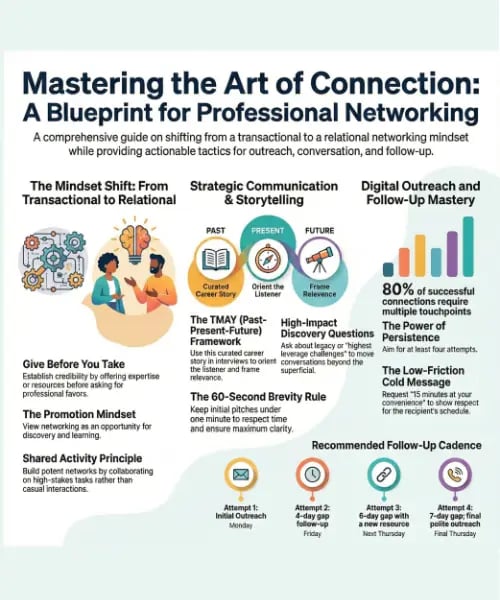
For these formal, more critical settings, a more powerful alternative is the "Tell Me About Yourself" (TMAY) framework. This is not a pitch but a curated career story designed to build relevance, frame the conversation in your favor, and position you as the ideal choice. The TMAY structure uses a simple Past-Present-Future model.
.
• Past: Start with the specific experiences that shaped your professional perspective and leadership style. Don't just list jobs; explain how key moments gave you the skills and insights you have today. This provides a foundation for your story and demonstrates a reflective, strategic mindset.
• Present: Describe your current momentum and key strengths. Focus on the measurable impact you are delivering in your current role. This part of the story shows what you are capable of right now and proves your value with concrete evidence.
• Future: Conclude by articulating the strategic problems you are prepared to solve next. Clearly state why you are pursuing a specific role or opportunity at this moment in your career. This connects your past experiences and present capabilities directly to the needs of the organization.
This storytelling approach moves you beyond being just another candidate. It positions you as a strategic thinker who is the natural solution to an organization’s most pressing problems.

3. The Smartest Person in the Room Asks the Best Questions
It’s a counter-intuitive truth of networking: the questions you ask reveal far more about you than any statement you could make about yourself. Shifting from a transactional mindset of "what can I say to impress?" to a relational one of "what can I learn?" changes the entire dynamic. A thoughtful question demonstrates that you've done your homework, that you are genuinely curious, and that you are thinking strategically.
This strategy immediately shifts the pressure from "performing" to listening and learning. High-impact, open-ended questions can transform a superficial exchange into a memorable and meaningful conversation.
Here are a few examples of high-impact questions that build genuine rapport:
• What inspired you to get into the work that you’re doing?
• What do you want to be remembered for?
• Right now, what’s the highest leverage challenge you’re facing in your career?
These questions are effective because they signal your professional sophistication, preparation, and emotional intelligence. They invite reflection and move beyond surface-level small talk, positioning you as a strategic peer rather than just another contact. By uncovering someone's motivations and challenges, you show respect for their journey and create natural opportunities to find common ground, offer value, and build the foundation for a lasting professional relationship.
4. The Real Work Begins After the Conversation
A transactional networker sends one thank-you note. A relational networker builds a connection over time. The real work begins after the conversation. The single most common networking failure is a lack of follow-up, which transforms a promising interaction into a missed opportunity. A follow-up is not just a polite courtesy; it is a critical, strategic part of the process.
To do this effectively, think less about a single message and more about persistent, planned outreach. A powerful parallel comes from sales, where 80% of prospects say "no" four times before saying "yes." While your goal isn't to close a sale, the principle of professional persistence applies. People are busy, and a lack of response doesn't always mean a lack of interest. In fact, one study on sales cadences found the typical gap between contact attempts was for 23 days, underscoring that planned follow-ups are a standard professional practice.
So what does this look like in practice? If you make your first outreach on a Monday, a professional follow-up could land on Friday (about 4 days later). If you still don't hear back, your next attempt might be 6 days after that, and a final one 7 days after the third.
Crucially, you must vary the message with each attempt. Instead of sending repetitive "just checking in" notes, add new value each time. Share an article you think they might find interesting, offer to introduce them to someone in your network, or reference a new insight related to your previous conversation. This demonstrates ongoing engagement and positions you as a valuable resource.
If you don’t get any response, it's wise to know when to stop. A good rule of thumb is to stop after the fourth attempt. This provides sufficient time to get their attention without becoming annoying. For your final attempt, you can graciously close the loop with a message like:
"I am sorry that we have not been able to connect. I wanted to speak with you and get your perspective about... If in the future you ever have a few minutes... I would be happy to hear from you."
5. The Introvert's Playbook: Aim for Depth, Not Breadth
If you're an introvert, the idea of a crowded networking event can be draining. But effective networking isn't about becoming an extrovert; it's about leveraging your natural, relational strengths. Forget the pressure to "work the room" and instead focus on what you do best: building authentic, high-quality connections.
Introverts bring powerful assets to networking, including deep listening, thoughtful engagement, and the ability to form strong one-on-one relationships. While extroverts may thrive on broad social interaction, introverts excel at building the kind of deep rapport that forms the true foundation of a powerful network. This focus on depth over breadth is the ultimate expression of a relational, rather than transactional, approach.
One of the most effective strategies for introverts is the "Rule of Two." Instead of trying to meet everyone, go to an event with the goal of having just two genuine, meaningful conversations. Once you’ve accomplished that, give yourself permission to leave. This approach reduces social anxiety, eliminates the pressure to perform, and ensures that the connections you do make are substantive and memorable.
Additionally, introverts can use digital platforms to their advantage. Initiating connections on LinkedIn allows you to be thoughtful and articulate in writing, a medium where many introverts feel more comfortable and confident. A well-crafted written message can be a powerful, low-pressure way to start a conversation that can later transition to an in-person meeting.
Conclusion: Build a Network of Relationships, Not Contacts
Ultimately, modern networking is not about collecting the most contacts; it’s about cultivating the most meaningful relationships. By shifting your mindset from taking to giving, trading your pitch for a story, asking better questions, following up strategically, and leveraging your natural strengths, you can build a professional network that is both powerful and authentic. The goal is to create a community of advocates who are invested in your success, just as you are invested in theirs. This foundation of mutual benefit is what will sustain your career over the long term.
What is one small shift you can make this week to start building a relationship instead of just collecting a contact?