
The Science of Dangerous Confidence Self Help Guide to Command Any Room
Learn dangerous confidence self help to command any room using calm presence, silence, and body control. Tactics to stop being overlooked and earn respect. Learn dangerous confidence self help to command any room using calm presence, silence, and body control. Tactics to stop being overlooked and earn respect.
SELF-IMPROVEMENT & PERSONAL GROWTH
E.O. FRANCIS
1/28/20263 min read


Dangerous confidence self help begins with understanding why capable people stay invisible in powerful rooms.
Many skilled professionals enter meetings and feel unseen, unheard, and ignored by louder personalities.
This problem is not low intelligence or weak skills.
It is a lack of presence shaped by biology, behavior, and social signals.
Most people believe confidence appears after feeling ready.
In truth, the body sends signals long before the mind agrees.
Posture, breathing, eye contact, and voice tone speak first.
The room reacts to these signals before you speak a word.
Dangerous confidence is not arrogance or noise.
It is calm control over your nervous system and social energy.
When mastered, the room adjusts to you instead of the opposite.
This guide explains how to build that level of presence step by step.
Takeaway One The Confidence Paradox
Dangerous confidence self help starts by removing the act of confidence itself.
Trying to look confident adds mental strain and self monitoring.
Your attention splits between acting and thinking.
Others sense this strain as insecurity, even if your words sound strong.
True confidence appears quiet and relaxed.
Experts do not announce skill or force respect.
They move slowly, speak clearly, and stay present.
Their comfort comes from self trust, not approval seeking.
When you stop chasing reactions, authority rises naturally.
You stop performing for the room and start anchoring it.
Silence becomes safe instead of awkward.
Your presence gains weight without effort.
Takeaway Two Master the Frame
Every social moment runs on frames.
A frame shapes how value and power are perceived.
Strong frames dominate weak ones every time.
If you do not set the frame, someone else will.
Dangerous confidence self help requires shifting from seeking time to offering value.
You lead by deciding fit instead of asking permission.
Scarcity changes attention fast when used with a calm tone.
People lean in when they sense they might lose access.
Disrupt common scripts to hold control.
Challenge dismissive behavior with light humor and calm firmness.
When time limits appear, offer to leave or condense value sharply.
If data drains attention, introduce tension through story and risk.
Strong intrigue follows clear rules.
You stay central to the story.
Risk and pressure must exist.
A clear obstacle creates emotional focus and engagement.

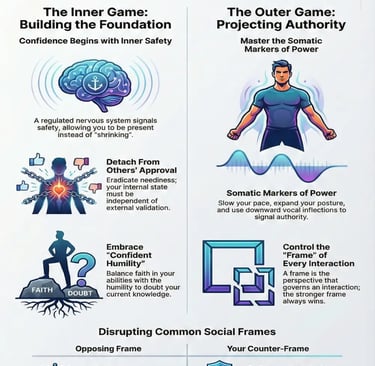
Takeaway Three Confident Humility
Dangerous confidence self help is not blind certainty.
Confidence often grows faster than skill in many people.
Low awareness creates false certainty and loud opinions.
High skill often brings doubt and self questioning.
The strongest leaders stay between both extremes.
They trust their ability to learn while questioning current answers.
This balance keeps ego low and curiosity high.
It allows faster growth and better decisions.
Operate like a scientist, not a preacher.
Treat beliefs as testable ideas, not fixed truths.
This flexibility builds trust and sharp thinking.
It also keeps you adaptable under pressure.
Takeaway Four Rejection Therapy
Dangerous confidence self help cannot come from thought alone.
Bravery forms through repeated exposure to social risk.
The nervous system must learn safety through action.
Avoidance strengthens fear, while contact weakens it.
Seeking rejection on purpose builds calm under pressure.
Each refusal teaches the body that nothing breaks.
Heart rate lowers over time in tense moments.
Confidence becomes stable instead of fragile.
Start with small discomfort.
Ask for favors or discounts without apology.
Move toward visible tension like public speaking attempts.
Eventually, high risk moments feel manageable and clear.
Takeaway Five Somatic Engineering
Your body advertises your internal state at all times.
Dangerous confidence self help uses posture and breath to send safety signals.
Open posture lowers stress hormones naturally.
Stillness removes nervous habits that leak insecurity.
Eye contact builds trust when held calmly.
Three seconds creates connection without pressure.
Voice tone matters more than word choice.
Lower endings signal certainty instead of approval seeking.
Speak fewer words with clear pauses.
Silence increases weight and attention.
Match the pace of respected figures in the room.
Remove physical barriers when possible to increase trust and clarity.
Takeaway Six Strategic Silence
Talking too much often signals need for approval.
Dangerous confidence self help values silence as a tool.
Silence frees attention to observe behavior and emotion.
You notice patterns others miss while they speak.
High status individuals listen more than they explain.
They allow others to reveal priorities and limits.
This information shapes stronger responses later.
Silence becomes control instead of absence.
Withdraw when chasing is expected.
Do not rush to fill space or prove value.
Calm distance signals independence and strength.
People respect those who do not beg for attention.
Conclusion From Performance to Presence
Dangerous confidence self help is built through practice, not personality.
Each action trains your body to feel safe in pressure.
Presence replaces effort when habits align.
Confidence becomes something you are, not something you do.
Stop apologizing for your space today.
Stand still, speak clearly, and pause without fear.
Others will feel permission to do the same.
That is how presence spreads quietly and powerfully.